1. In what ways does your media product use, develop or challenge forms and conventions of real media products?
When producing a thriller movie it is essential to conform to the conventions of a thriller. The main aim of applying conventions is to make the audience ask questions and to add mystery and suspense.
In our movie we tried to use the main conventions of a thriller so that our movie fits the genre.
I am going to list and explain the main conventions of thrillers to which apply to our film whilst also discussing how they develop or challenge the conventions of real thrillers.
1. CAMERA MOVEMENTS AND ANGLES- http://www.mediaknowall.com/camangles.html

Camera movements and angles are a very big part of conventions of thrillers. Using different camera angles and movements create varied senses of body language and emotions. In our thriller we used a range of shots and angles such as a close up of the main characters face (Laura). This puts the viewer close to the the character on the screen resulting in them feeling similar emotions to the character. We used a close up here because many people find being that phyiscally close to someone threating and uncomfortable, this resluts in the viewer feeling like they are part of the film, they are also able to recognise the characters emotions very clearly. An example of this technique is used in the film 44 inch chest, the viewer is made to feel uncomfotable being that close to the character.
2. TRACKING
Tracking is a brilliant technique that is a convention of thrillers. Tracking makes the audience feel like they are following the character. By tracking it results in the audience feeling similar emotions to what the character would be feeling as they feel like they too are part of the movie. Tracking is commonly used in real films to create suspense for the audience as they do not know what is going to happen next. An example of this is in the movie, 'The shining' -
https://www.youtube.com/watch?v=tSpbZiTx724 The audience are left in suspense as the tracking happens for a very long time, therefore they do not know what is going to happen to the child creating questions.
3.QUICK CUTS

Quick cuts are commonly used in thrillers and have become a convention. Quick cuts are also seen in films such a psycho, where the woman in the shower is getting stabbed, there are a lot of fast cuts, to show different angles of her being stabbed, this makes the film fast paced, more tense and adds suspense. In our film we used quick cuts of the main character opening the cuboard, getting the objects out and placing them on the floor. These quick cuts add suspense as if something is about to happen next.
4.TITLE SEQUENCE

Title sequences may seem like they just tell you who is in the movie but when you really concentrate on them you can see that they take alot of time and thought to make. Title sequences are a very big part of conventions of thriller movies as in thrillers they usually give an insight to what the movie is about and usually will show something that is significant within the thriller. We based our title sequence on the movie 'One hour photo'. The title seqence goes through a black screen, but when each sentaence is revealed on the screen there is a flash and sound of a camera. We took this idea and used it as inpiration for our thriller. As the cuboard is closed in the first scene the screen goes to black and as similar to 'One hour photo' as the text comes up a flash behind the text is made and a camera noise is made. We felt like our title sequence gives a real insight to what our thriller is based apon, a photo.
5.PROTAGONIST AND ANTAGONIST
Thriller films commonly use
protagonists and antagonists. The protagonist is usually portrayed as the 'good' character. The oppisition of the protagonist is a character known as the antagonist who creates problems that the protagonist must overcome. There may be more than one antagonist or protagonist in a story. Protagonists and antagonists are a convention of a thriller as usually the protagonist is a woman, this is because she can show vunerability and reason for an antagonist to create trouble, we used this theory in our thriller as we wanted the woman to seem helpless and a target for a the antagonist


ANTAGONIST PROTAGONIST
6.LOW KEY LIGHTING
Low key lighting is a very popular convention of thrillers. It adds mystery and creates an ambience of 'spookiness'. We used low key lighting in the cupboard scene (shown in the picture below) which was also helped by the fact that the cupboard was naturally dark. However I do think that we should have used more low key lighting throughtout the opening as lighting was something I feel we lacked in, we could have concentrated on the lighting more to create a sense of mystery.
7.SIGNIFICANT PROPS- http://en.wikipedia.org/wiki/Plot_device
 Significant props are key in thrillers as they are often used as the main focus of the plot, they can either hold clues (like inception where the spinner holds clues), let the audience in on a secret or make the audience ask questions. The significant object we used in our thriller is the missing photo this makes the audience ask questions as they do not know who the photo is of.
8.SETTING
Significant props are key in thrillers as they are often used as the main focus of the plot, they can either hold clues (like inception where the spinner holds clues), let the audience in on a secret or make the audience ask questions. The significant object we used in our thriller is the missing photo this makes the audience ask questions as they do not know who the photo is of.
8.SETTING

Settings is a very big convention in thrillers, the setting has to be well thought about, you cant just have a thriller set in a random swimming pool with lots of people, as this is not something that will make the audiense feel intreged. Alot of films use settings that the audience would connotate with fears, such as jaws is set in the water, a fear that many people hold. In our thriller we used a lounge, a normal setting that the audience can relate to but our biggest setting was the cliff, alot of people fears are? hieghts. This puts the audience on edge and makes them think about the danger that the character is in, and makes the audience do the one thing directors want them to do, ask questions.
9.NOT SHOWING IDENTITY.

many films do not show a certain characters identity, this results in the audience thinking for themseves and coming up with thier own conclusions and makes the audience ask questions. It also creates suspense for the audience as they do not know the characters intentions in the film. Usually thrillers use not showing a characters identity by tracking a charcter, this also adds more suspense (tracking explpained in point number 2).
2.How does your media product represent particular social groups?
Representation of 'social groups' can be shown in a number of ways such as, mis en scene, sound and camerawork. Mise en scene is seen as the most important way of representing a character as it shows thier true self within thier environment.
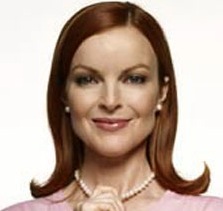
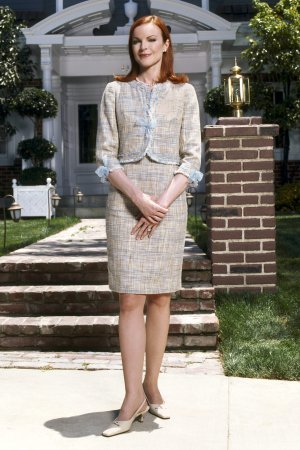
http://www.youtube.com/watch?v=ju00z20MKgQ - link to bree van de kamp desperate housewives.

First of all I am going to look at the woman, in our opening she is represented as high class and middle aged. I chose to base costume and ways of living on the character from desperate housewives, Bree Van De Kamp. She is represtened as someone who likes everything to be neat and perfect, and always has to be imaculate. We based our female character on Bree and used similar traits to show this:
1. Immacualte hair.

2. matching clothing.
3.pearl earing and necklace.
4. perfect environment.
The way we dressed our character is very similar to Bree. Both are wearing pearl earlings and a pearl necklace, this can be accosiated with sopifistication and maturity. Additionly, matching clothes are worn to show smartness and perfection. Nothing is out of place within both of thier appearences, this shows that they look after themselves and care about what other people think. We really concentarted on the costume for our female character as it represents her, this is key within out film as her neatness is also shown in when she is looking through herohto albumn, all the photos are lined up and not one out of place, this is why when the photo is missing from the albumn the audience can imidiatly see that it is significant.
We used the living room as the main setting as it is usually the heart of a families home, and the room that is most 'lived' in. Again, the living room is very neat, tidy and all furniture is matching. Furthermore her need for everything to be immactulate is empaised when our female character walks into the room and immidatly starts to make sure the cushions are in the right place. Both her appearance and her living space represtents her and shows connotations of sophisticantion and high class.
Camera work is used also to show her representation, when she first walks into the room we used a long shot to establish the setting and also put empasis on the closeness of the
match on action of the coasters. These factors again show her neatness within the way she is represented. We also used
non diagetic sounds, classical music to show her high class status.
We chose to use a woman for the first scene as the way we represented her being so neat puts an empasis on the missing photo as the audience would start asking questions such as 'why has someone so tidy lost a photo?'. Our character also shows vunerbility and a motherly appearence, so that the audience assume that the person in the photos was someone young and close to her.

Secondly, we have the male character. The male character is wearing dark jeans and a green hoodie, this refers to a steareotypical view that the audience will have, resulting in the audience thinking he may be from a poor background and asking questions to themselves about how the two characters are connection when the seem and look so different. His hood is up so that the audience cannot work out his age. This leaves more of a mystery. Again, he is sat on a cliff, and not in a house or somewhere comfortable, this makes the audience ask questions to themseleves, is he homeless? where does he come from? A cliff also has connotations of sucide, so the audience are not sure what he is doing there. Overall we didn't reveal much about the male character so the audience come to conclusions themselves.
3.What kind of media institution might distribute your media product and why?
When releasing a film it has to go through 3 stages, prodction, distribution and exibition. Now that technology is developing, distributers have many more ways of releasing the movie, some of these are:
- CINEMA: cinema is a very popular way of showing films, however they are more focused on big block buster films rather than UK low budget films as it is very expensive to print at £1800.
- DVD: some films go staright to DVD, this means that the audience can buy a copy from places such as amazon and watch the film in th comfort of thier own home which for some people is more apealing than going to the cinema.
- DOWNLOADS: Downloads again are very similar to DVD, again they can be downloaded to game consoles, ipods or phones and watched in the comort of thier own home or on the go.

They look very closely at the audience, the right choice in how to exibit the film aimed at thier auduence results in money.
After doing my own research i have decided that due to my range of age in audience it would be appropiate to go straight to DVD, allowing it to be purchaced from sites such as amazon.co.uk and play.com. I made this decision because after doing reseach i found that many low budget films went straight to DVD and used online sites (
Amazon ect) so that the DVD could be purchased at a reasonable cost and sent straght to the audience so they can watch it in the comfort of thier own home. I chose not to do exibit by ipods and downloads as i feel that it would not apeal to the older market due to the fact that generally younger people use technology more and i feel that downloads would not reach my older audience. I also chose not to exibit by cinema as after doing my research more and more people are finding cinema expensive and prefer to purchase a DVD so they can watch it from the comfort of there own home. After reseaching on the internet i found a few comments that suggested my desion to exibit through DVD was the right choice.
4. Who would be the audience for your media product?
In order to answer this question i did my own research in finding out the age range and gender than prefer thrillers. I asked 25 people of different age ranges and gender if they liked thrillers, here are my results:


From my results I can see that the age range most popular for thrillers is 12-18 and the least popular 26 plus. In addition to this females prefer thrillers to males however the results where very close. Using my results and looking at the BBFC guidelines, i have decided that the classification for my film will be a 12A as it does not have use of drugs, sex or violence and generally the film cnforms tothe classification. I believe that from looking at the BBFC website and from feedback from my audience that 12A is a suitable classification as it conforms and is acceptable to age range of 12 and up.

5.How did you attract/address your audience?
As you can see from the feedback I collected in question four, i have established that my audience is for ages 12- 25. My audience would enjoy my film through narrative, camera work, editing and sound.
1.Narrative: Children under the age of 12 would not enjoy the film as it may scare them and they would be too young to understand the story. The narractive is aimed at a slightly older audience as it is difficult to completely understand, the narrative needs to be thought about and unstood in order for the movie to be enjoyed. As the woman was clearly a mother this helps possibly the older audience relate to her as a parental figure, and her having lost a child, this appeals to the older audience as they can relate to her being a mother. The younger audience would relate more to our second character, as he is persumed as younger.
2.Camera work: we used alot of close ups and medium shots to show the characters emotions and their actions in detail, this is because as i mentioned in the narrative section the story is hard to follow, and therefore by putting empasis on these certain aspects, the audience can take thier time in concentrating on the narrative. As the woman walks into the living room the camera is kept behind the wall, this gives the audience the suggestion that we are following her and again this adds more suspense.
3.Sound:
The sound at the begging of the opening is classical music which will apeal to the older part of the audience. The balerina music is diagetic, the female part of the audience can relate to the balerina music as as a child they may have had a balerina jewelerry box themselves. As we move onto the second part of the opening we go to the non diagetic House of leaves music which is very intense, as the music carries on and the boy stands up to what the audience assumes is to jump the music gets more and more intense, giving the audience the 'thrill'.
4. Editing:
Fast editing such as fast cuts adds suspense and keeps the audience on the edge of thier seats. As the woman is looking for the photo the cuts get faster adding to her franticness in looking for the photo.
Overall we attracted all of our audience, the older can relate to the woman with her motherly features and the younger can accoiate with the boy. However both ages have the knowledge to understand both characters. The editing, sound, camera work and narrative all make the audience have the 'sitting on the edge of your seat' thrill.
6.What have you learnt about technologies from the process of constructing this product?
I tried to upload the video straight to the blog however it wouldnt play and also resulted in the work i had written to not be saved and kept saying 'error saving'.
7. Looking back at your preliminary task, what do you feel you have learned in the progression from it to the full product?
From doing the preliminary it was a very good learning curve for us as a group and myself individually. Overall I was very pleased with our preliminary, we used match on action which we used when the detective was opening the door into the room and when the detective slammed his fist on the table in anger during the interview, this entertains the auidance as it makes them jump and add suspense. Additionally we used
shot reverse shot when the two characters are having a conversation across the table. Further more we put the audience in the perspective of the criminal, this adds suspense as the audience would be imagining they are the criminal, and therefore will carry the same emotions and reactions.
In our preliminary we made a few mistakes (which we then learnt from and made sure we did not make the same mistakes in our thriller.) Our first mistake was that we broke the
180 degree rule when we filmed the detective was on the right side however when we shot over the detectives shoulder we filmed it on the left side, this resulted in the 180 degree rule beig broken and the dougnuts were on the wrong side. We then fixed this by using
final cut pro, where we flipped the shot over so the detective was on the right side. Our second mistake was that we forgot to reset the white balance in a few shots resulting in the quality and colour of the picture being poor, to fix this we then reshot the footage making sure the white balance was set in every single change.

As we were proud of a number of techniques we used from our preliminary we decided to use similar ones in our thriller. We used match on action when the woman is adjusting the coaster on the table, this empaises the importance of her wanting everything to be tidy and perfect. From the mistakes we made in our preliminary we took more care when constructing our shots and personally I think we progressed alot from our preliminary and our quality in filming improved by leaps. As we had a HD camera when filming our thriller we didn't need to reset the
white balance.
Personally one of my favourite shots from our thriller was the shot where the woman opens the cuboard. As she opens the cupboard a focus pull is performed, this distorts the shot until the cupboard is fully open, then everything is crisp and clear. I love this shot because i think it demonstrates how much we thought about our shots when doing the planning for our thriller.
Even though our thriller was very good, there were a few mistakes along the way, when we first shot the living room scene we did it in lauras house, i think we were quite nieve about how much filming we would have to do and by the end of the shooting i think we were tired and our filming reflected that. So we decided to reshoot in my lounge, with a clear view of the exact shots we wanted and those shots were the ones we used for our final product. Myslef and Meg worked on doing a title sequense for our film, we got our inspiration from the film 'one hour photo' , we had the text appear on the screen and then a photo flash and sound appeared behind, i think this will engage the audience and give them an insight into the film.
Overall i think we have progressed alot from the preliminary, we made some mistakes in the preliminary and did some good shots, we took inspiration from the good shots and learnt from the mistakes to make sure we didn't repeat them again. I think the quality of our film was alot better than our preliminary because, we learnt from our mistakes, we had an HD camera and we carefully planned and constucted the shots we wanted.
.jpg)


 as i look back on our preliminary I feel we have come a long way because as we filmed our Preliminary we came across many disagreements as we were recording however when we came to our final film we all had a clear understanding on what we wanted.


.jpg)






.jpg)