1) In what ways does your media product use, develop or challenge forms and conventions of real media products?
- Todorov Theory - this theorist came up with a basic structure for all genres of movie: Equilibrium, Disruption and a Resolution. One Thriller that uses this is Johnny English Reborn. This starts with English at an abbey where monks live, learning how to fight like them. This represents the life that he is living now.
However, some Thriller's manipulate this chronology in order to create variety, as this moves away from a stereoptypical setting of a Thriller, thus providing more entertainment for the audience. An example of this is Salt. This uses two disruptions as we start by seeing that the protagonist has been taken hostage; clearly a disruption. This intrigues the audience, and then we see an equilibrium back in her life and her job. However, then there is another disruption when she is accused of being a spy; raising lots of questions as to why there are so many disruptions in her life and what they mean. Another example of a film that manipualtes the chronolgy is Inception. This clearly starts with the disruption as we see the protagonist is in an unknown location, surrounded by men with guns. However, after this scene we do not see an equilibrium; it does not have a clear order. This intrigues the audience and gives an idea as to what the plot is about: as the lack of order shows the way he jumps between dreams. In our film I have conformed to this, above there is a short video explaining why... - Vladimir Propp's Character Theory - this theory stereotpyes the main characters used in Action and Thriller type genres. This theory states that the protagonist is usually a man, who is the hero. We see this is many films, such as Indiana Jones in the Action genre, and Sherlock Holmes in Thriller. However, many more films are starting to challenge this idea of the male being the hero, as times are moving on with the ideas of equality. For example, we see that films such as Salt and Lara Croft feature female portagonists. Our film too challenges this idea, as we have a female protagonist. We have chosen to do this as the film is all about a missing girl, and females are traditionally seen as more motherly, therefore we feel that the audience would be more likely to empathise with her.
- Roland Barthes 5 Codes -
- Hermeneutic Code - This refers to Enigma, which means that the audience are constantly asking questions. This is extremely important within the opening, as this is what intrigues the audience into watching the rest of the film. For example, we can see this within the film 44 Inch Chest. Lots of questions are raised, as we see a modern looking apartment that has been burgled: Who burgled it? Why? We then see a man lying on the floor: Is he dead? However, then we see a close-up and he is breathing, but looks injured: Is he alright? Who did this to him? He is quite sweaty, was there a fight? Then we see that the door is open: did the burglars just escape? Then a new scene introduces a new setting, where there is quite old fashioned furniture, contrasting to the modern apartment: what relation do these characters have to the man in the previous shot? All films must be able to raise quesions within the opening. In my opening scene, we raise lots of questions to do with the indiviual characters, as well as asking the question of how they are connected to each other. For the female we wonder: what is she looking for? what is the significance of the photo album and jewellery box? (shot 1 and 2) And for the male we wonder: why is he tearing up the photo? why is he standing on the edge of a cliff? why has he got his hood up so we cannot see who he is? (shot 3 and 4)
- Symbolic Code - this includes binary oppositions. I have used this by contrasting the representations of the female and male characters (see question 2) so that it emphasises the sense of enigma when they are asking how the characters are connected. Binary oppositions have been used in Pirates of the Carribbean, as Bellla Swan is a high class woman, daughter of a judge with very high social standing, whereas Will makes swords within the town. This binary opposition has been used to heighten their love; they are not meant to be together but they are.

- Suspense - this must be used in Thrillers in order to achieve their aim: 'keeping the audience on the edge of their seats'. The famous Thriller director, Alfred Hitchcock creates susepense in many of his films, here is a link about how he does it in Birds. Suspense can be created in many ways, such as fast pace editing and sound. I have used sound within my opening to create this. This is especially seen in the second scene, as the music I used was the House of Leaves, which is very intense and mysterious. We also used the sound effect of a banging drum to heighten the sense of tension at the end, above is a short video telling you how I got this...
- Low Key Lighting - this is used for the cupboard scene (shot 3). Throughout the first scene, I used high key lighting as it relates to the representation of the character (see question 2), however, the cupboard scene is where she is frantically searching, so must therefore have more suspense. This could be achieved better with Low key lighting as the darker lighting holds the connotations of mystery. The cupoboard gave us the oppurtunity to do this, as it had dark wood so there was no light in there, meaning that we only had to have light coming from the left outside of the cupobard and behind the character to make it low key. We had the light coming from the left - which is the Back Light in Three Point Lighting - so that you could still clearly see her expression, and the worry that it portrayed.
- Significant Objects - objects are used to drive the plot. They are often used in Action films, where the hero must go on a journey to retrieve an object, however, they are used in Thriller's too. We see a significant object in the opening of Inception, the spinner, which clearly holds clues that we will find out about later in the film. A focus pull is used in order to emphasise the significance of the spinner. I use significant objects in my film to help drive the narrative and hold connotations (which conforms to Roland Barthes Connotive Code also often used in films). Examples of this are: the missing photo (shot 5 and 6), as this is what gets our main character worried (shot 7 and 8), therefore frantically searching for it, allowing the audience to ask why she is so worried about this photo. There is also the ballerina jewellery box (shot 1), as this is pink and has a ballerina in it, therefore perhaps signifying that it belonged to a young girl (in shot 4 the missing photo is put in the frame alongside the ballerina bo, further suggesting the connection between them). It is in the cupboard along with the photo album, and the character is very reminiscent of it, therefore the audience questions what significance it has in her life. Furthermore, the music stops as she finds out that there is a photo missing; conveying that there is a correlation between them, thus allowing the audience to contemplate this correlation (shot 9).
.jpg)
Representations of character can be shown through mis en scene, editing, sound and camerawork. More commonly, mis en scene is used to portray these representations as it allows the characters to conform to stereotypes, even furniture can create.
The female character is my protagonist. She represents a high class, middle-aged woman.

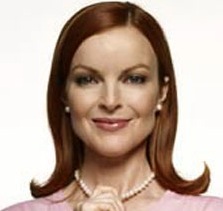
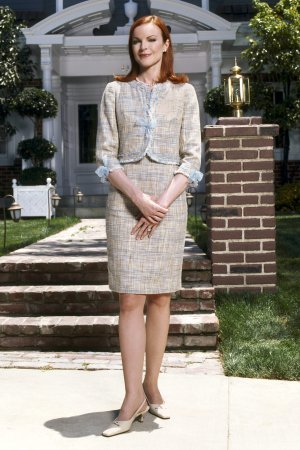
Mis en scene (costume) - We got our inspiration for her costume from Bree in Desperate Housewives, who is represented as a "perfectionist". as she also represents a high class woman. These similar costume traits are: pearl earrings and a pearl necklace, as they hold connotations of sophistication. The character also has straight hair, which holds the connotations of immaculacy, and that she also cares for her appearance. The audience can infer that she does this so that she can keep a good, high class reputation. Bree has a matching cardigan and high-cut top, as does the female character in my opening. This further conveys her smart appearance, and her well-mannered nature, which is seen as an aspect of being high class. We see Bree's full costume in another photo. She is wearing a woman's skirt suit, which has the connotations of being well-fitted, therefore signifying that it was expensive, and it's sophistication. We have used the same style, with the use of a skirt and cardigan, however, we have used a pencil skirt instead of the one Bree is wearing. This is commonly known as a 'power suit', therefore it gives the female power. This furhters her sense of being high class and it also links to her role as protagonist; she is the one with power.
 Mis en scene (setting) - the setting that we use is a living room. The base colour is cream, which, like pearls, has the connotations of sophistication.Furthermore, it is seen as a very tidy colour as it must not get muddy or dirty, therefore it reinforces this sense of immaculacy that the character conveys. Furthermore, the pictures, fire and sofa have a very old fashioned style. This contrasts with the modern cream colour, and also highlights the contrast we have in the characters. Her pearls and old fashioned furniture represent her sophistication, yet her 'power suit' and cream carpet creates a more modern aspect. The sophisticated side may represent her high class status, yet the modern aspect reinforces the way that she is a caring mother, therefore the audience are more likely to empathise with her.
 - Camerawork - we used a long shot when the character enters the room. This allows them to see the way that her costume matches her immaculate living room, therefore furthering her representaion. Match on Action (a part of Continuity Editing) is also used when she is putting the coasters into place. This reinforces the representation that she wants everything to be immaculate.
- Non-diegetic Sound - I have also represented her high class status through the music used. I have used Frederic Chopin's Prelude - as it is very famous we did check that it was royalty free - whilst she is getting ready, such as putting on her pearls, and tidying the living room. Chopin is a Polish composer, and it is seen as very high class. His prelude has almost dainty, and relaxing connotations therefore we thought it would work well to represent her high class status, where putting pearls on is her morning routine.
- Editing - we created a slow pace when cutting in order to reflect the slow pace of Chopin's prelude.
- Why did I choose to represent her in this way? There are two reasons as to why I chose this representation for the woman. Her high class status shows to the audience that she has money, so therefore it allows the audience to question (see question 1 for the Enigma convention) why it is her daughter that, they assume, has been taken. This idea is influenced by the character in the film, Ransom. IMDB describes the character to be a "rich man", therefore giving the people who took his son a motive, as they may ask for a ransom, therefore the audience could connect this idea to my character. However, rather than making our character a man, we have mader her an older woman, so that she looks more motherly, so the audience are mor likely to empathise with her when they see that her daughter is missing. Alternatively, her furniture and her appearance all signify the way she likes things to be immaculate, therefore nothing is out of place. This then intensifies the significance of the missing photo, if someone who is so tidy, loses it. This allows the audience to start coming to the conclusions that she therefore did not lose it, but that someone has taken it.


The male character represents a teenager, who is of a much lower class to the female.
 Mis en scene (Costume) - the male character is wearing dark, skinny jeans and a dark hoodie, with his hood up. The dark skinny jeans represent his age: he is a teenager as his fashion conforms to modern teenage style. His hood is up so that his identity is concealed; this means that the audience will be more intrigued as to who he is, and how he relates to the narrative and other character. Whilst asking for my audience feedback, two people agreed that concealing his identity was a really good aspect, as it meant that we did not know what "mood he was in", and so therefore could only rely on the action to tell whether he will "jump off the cliff". Below are the comments.
- He is wearing dark green and black, which are oppressive colours, signfiying his clear anger and misery. This furthers the audiences question: why is he angry? Finally, his costume is a clear contrast to the females. She looks very immaculate, whereas the teenager looks more 'scruffy'. As well as questioning their ages, the contrast between high class and, possibly, lower class, again allows the audience to contemplate and be intrigued by their realtion to each other.


- Mis en scene (Setting) - he is placed on the edge of a cliff. This intensifies his anger and misery that is shown, though he does not jump off, it allows the audience to foreshaow what happens. This further links with his concealment of identity; if he jumps the audience will never find out who he is, therefore increasing their want to know the relation he has with the other character. An establishing shot is used to reinforce the height of the cliff, intensifying it's dangerous element. Finally, this setting further contrasts his character with the female, as she is in a safe, immaculate home, whereas he is on the edge of a cliff.

- Mis en scene (props) - He tears up a photo (print screen above), and the audience have previously seen the female looking for one. This finally indicates to the audience that there is a connection between them, yet they do not know what. Furthermore, we can also look at mis en scene in terms of expression. He is angry, and tears up the photo, whereas the female is distraught at the fact that she has lost it. This carries on representing them as contrasting characters; further intriguing the audience as to what their connection is.
3) What kind of media institution might distribute your meadia product and why?
Now that technology is becoming more broad, it allows many different ways for film distributors to exhibit films. These are the last two stages in the three stages of making a film: Production, Distribution then Exhibition. These last two are closely linked, as the distributors have to find a place to exhibit the movie, whether it is at a cinema, or for home viewing. They must look closely at the audience whilst deciding this, they know what attracts their audience, and so must exhibit it in the right place; therefore grosing as much profit as they can.
One of the ways that films can be distributed is through downloads on the ipods. This could be a popular form of exhibition as they are portable, and so are very convenient for the viewer. However, having done my research on my audience I am not going to use this idea. My audience is very broad; ranging from teenagers to adults (see question 4), but I do not feel this will be a popular form with the adults, and I want all aspects of my audience to see this. This is becuase this sort of technology is stereotpyically viewed to be a teenage form of tenchology, as they are the age range that are seen as the 'technology generation'. I know this becuase 82% of the ipod market is teenagers (2006 survey).
The cinema is a very popular form of exhibition and has allowed many Blockbusters to grose a large profit in the opening weekend. However, the cinema is very expensive in many aspects. It is expensive to exhibit it, as there are 2860 cinemas in the UK, however a print is £1800. It also needs lots of advertising, meaning that the distribution budget would need to be very high. However, cinemas are very popular for High Concept films, however, this is a low budget UK Thriller meaning it may not be that popular, therefore I do not want to risk this money. Furthermore, not even all Blockbusters do well at the cinema. A recent film John Carter, has shown this as it is "Disney's biggest flop of all time", with an operating loss of £200 million. I can also argue that the cinemas ticket prices are getting more expensive, resulting in less viewers.
 Another way that many UK films are distributed is through touring around the UK. When I was doing my research using the British Film Institute I found a UK film called 'Laura', which is only touring in small cinemas, places like the Duke of York in Brighton . As it is touring on certian dates, it means that people are more likely to make time to go to it, as there won't be another chance. However, I am not going to use this way as I feel that it will need extensive advertising and not grose as high a profit to cover it.
 Another way that many UK films are distributed is through touring around the UK. When I was doing my research using the British Film Institute I found a UK film called 'Laura', which is only touring in small cinemas, places like the Duke of York in Brighton . As it is touring on certian dates, it means that people are more likely to make time to go to it, as there won't be another chance. However, I am not going to use this way as I feel that it will need extensive advertising and not grose as high a profit to cover it.
 I have decided to distribute my film using Netflix. It suits my audience as it is a "common past time for teenagers and adults". It is also an increasingly popular account to get, with "15 million subscribers". I can distribute it by inviting the account users to a preview for it. This is similar to what Sally Potter did for her film Rage, except she did this through Itunes, which is a very popular networking site, as it has over 150 million users. However, I chose to use Netflix as it is specified for films, and it is winning in the contention between Apple, Blockbuster and Amazon. This is because these use "per rental fees" and "downloads" whereas Netflix uses subscriptions. Based on this chart, I can see that their sales have stayed consistent, therefore I can infer that they are a reliable source to use. In addition, I can also use Youtube for distribution, because as well as Netflix is is also very popular for films, as it is the "worlds most popular online video community", though it is mostly seen to be for music, it can also be a good way to "upload and share videos", therefore between Netflix and Youtube my film can be distributed to my target audience.



4) Who would be the audience for your media product?
 In order to decide which audience certification I should give my film, I posted a qestion asking the age range for me film. The 11/ 12 people thought it would be an 11-17 age range, allowing me to come to the conclusion that it should be a 12 certificate. I used the BBFC to see if this was the right decision. I believe it is, as there is no bad language, no sexual content, no drug use, it conforms to many other of the aspects of the 12 certificate. There is one aspect that says no "dangerous behaviour", which does include our suricide scene. However, through the use of effects, for example the cut at the end, does not show the actual act taking place, allowign us not to "dwell on detail". Furthermore, I found from the audience feedback that it is not actually clear if he is going to jump, other suggestions were that "he could be hiding", therefore it is not glamourising this thouhgt of suicide, or actually showing it.

Though the majority of the voters decided it was for 11-17 viewing, I agree with the other voter 'Nick Geall' that it is for 18-35 and 11-17. I think this can be to do with the representation of character (see question 2) as there is a middle aged woman, alongside a teenager. This features all age ranges of my audience, therefore making them more likely to watch it. I feel there will also be parents in this audience. We can see how much the, suspected, parents in the film care for the child. The woman with the way that she still keeps this baby's things, and still finds sentiment within them. Alternatively, we also see this in their mirrored action of circling their finger on the photo, to show they are specifically looking at the baby. The way they both echo this same action also furthers their connection as characters.


One of the audience members that gave feedback agrees with this, but suggests that it is "teenage mothers" as you can see from the print screen below.

Finally, another audience member agrees that it could also be aimed at adults, with the wider and "sad" concepts that are featured. The idea of a baby missing, is not somthing stereotpyically seen in a "teen flick".

5) How did you attract / address your audience?
Below is a print screen of a Facebook Feedback Comment.


Though this is a simple declaration as to who the audience is: it's true. Thrillers are meant to be intense and mysterious in order to 'thrill' you, and have you on the edge of your seat, therefore people under this age will not enjoy this in a film. I have used sound in my film whihc is very intense, such as the baby laughing in her head and the House of Leaves soundtrack. The House of Leaves soundtrack is very tension building, as it slowly gets faster as we see the character getting angrier; overwhelming the audience with the idea that he will soon jump. This is what they want, as adrenaline in the audience is what fuels the thriller and makes them want to carry on watching.
This is also shown in the editing, when there is fast editing we feel the suspense building. This is illustrated with the fast cuts when she is feverishly looking for the missing photo, frantically looking through the album, with the fast cuts in between the different angles of the her and the photo album. The action gets the audience's heart racing, but also the eerie, and tensional ballerina box sound on reverse also adds to this sense of being 'thrilled'.
 I have also portrayed this with the use of camerawork, when there is the shot of the female walking into the living room, but the wall blocks our view of her. This gives the effect that we are watching her, but with the way that we are hidden makes it seem as if we are not meant to. This holds sectretive connotations, allowing the audience to haev an eeire sense about them. Furthermore, with the way we are watching her, it gives the effec that we are perhaps put into a Point of View shot. There is no Eyeline Match used, to signify that there isn't actually a person there, however it intensifies the mysterious and secretive nature that we now percieve her actions to be.
Often you see fantasy thrillers, such as the Haunted Mansion and Pirates of the Carribean that are rated PG, however these specificaly target a family audience and so I have found, that on average, most Thrillers are a 12 certificate and over.
Looking at my audience in a more detailed aspect, I have found that the main way that my opening appeals to my audience is beacuse it looks at concepts that relate to them. For example, we see that her baby is clearly missing, or has been taken. This allows the older members of my audience, or possibly the young mothers, to empathise with her and this narrative, allowing them to feel more connected to it. We have made the representaion of the female character similar to the representation of 'Bree' in Desperate Housewives, this, like my thriller also targets an older age range, as they can identify with the character, with her big house and kids, it creates a struggle, therefore they can empathise with Bree, as well as my female character. We do not know how the characters are related, and so this may allow us to contemplate grief among the family. Their representations contrast, however this does not mean that they are not related, it could just show the effects that grief has upon families and the way differnet individuals deal with it, with the suicide perhaps signifying that this has happened recently. The widely seen concepts such as suicide attracts my audience as it creates a sense of realism to the film. This allows the audience to feel more connected, as all of the issues raised in the opening are extrmely relatable themes, thus appealing to my particular audience. This allows the audience to be interested in the opening, they want to carry on watching the film in order to find out what happens to the characters that they now feel so connected to. The common conventions of the Thriller then further this interest, as the sinister undertones to the piece suggest that there may be something bad happening. The suspense from the House of Leaves and the non-diegetic drum sound effect implies that the character is about to jump. Also, the creepy diegetic ballerina music signifies a child's box, however, when it is put on reverse, it also holds creepy and sinister undertones, again indicating possibly that something bad has happened, especially appealing to the adults or young mothers watching, as they can too feel these feelings and emphathise with her. Alternatively, the way she brings these items out of the cupboard, could show her neglection towards them; perhaps they are trying to move on with their life but finding it difficult. With the way that the openign does not answer any questions we can interpret their relationship in terms of their class representation. Perhaps they were together but they weren't supposed to be, and this baby is provided as a symbol for their illegitimate love? These interpretations can be addressed by my audience, as they may be issues that are in their life, or perhaps the media around them. I can look at other films that conform to the similar interpretations of this opening, such as Taken and Ransom. These are much higher certificates, being 15 (Taken) and 18 (Ransom), meaning that they address their audience's in a different way. They may have much darker themes within the film, perhaps violence when fighting to get their children back. I can see the darker nature to the films just from the film posters, as the low key lighting represents the dark themes to the films, the way that the lighing makes them seem like silhouettes signifies mystery and the red titles hold connotations of danger. However, my film, though it interprets these same views, the missing photo is the symbol of the baby, and there are no dark and violent actions towards this, the audience are only made to contemplate her feelings.


6) What have you learnt about technologies from the process of constructing this product?


List of films using Final Cut Pro...http://marylandfilms.com/2007/07/final-cut-pro-is-used-for-professional-editing-but/
7) Looking back at your preliminary task, what do you feel you have learned in the progression from it to the full product?
During the Preliminary, we made two big mistakes, where we actually had to reshoot the footage. There is an example of these below in the form of print screens. Our first mistake was to do with Continuity Editing, as we broke the 180 degree rule. This was because we had the detective on the right side. However when we were doing the shot/reverse shot, we shot over his left shouldher , meaning he was on the wrong side. We did not need to reshoot this though, as we could fix this using the effects on the editing. We did this by selecting the shot, and then using 'Flop', which meant that the shot would flip over. These are the two shots, the first one is the right shot which we used in the final task. We also forgot to keep resetting the white balance, this meant that we actually had to refilm the footage. Whilst we were doing our Thriller, we had a HD camera, therefore this set the whitebalance for us so we did not have to worry about it. However, it was still a big lesson that we learnt for the future.


We did also do some really good examples of Continuity Editing in our Preliminary, such as Match on Action, which we used twice. We used it when the detective was walking into the room, opening the door. We used this with a series of other shots of the detective, in order to create a fast pace, and therefore this Match on Action kept this pace going to carry on creating suspense for the audience.
We also used Match on Action during the dialogue. This was used when the detective was getting angry at the criminal, as we had an extreme close up of his hand being slammed onto the table. The extreme close up evoked shock in the audience, and it further intensified the detective's anger.


I also used Match on Action during our Thriller. The Macth on Action of her tidying the coasters intensifies the way she must have everything immaculate, reinforcing the urgency of the photo that is not in it's place (you can see these print screens in shots 8 and 9 in the frame).


 We have progressed lots from the Preliminary, though we did use some really effective shots in the Preliminary, like our Canted Shot (print screen below), and the good effect we used to portray a security camera (print screen below).
We also used other conventions of Continuity Editing. An example of this is when we used Eyeline Match. We used this to put the audience in the perspective of the criminal. This then therefore heightened the tension they were feeling, as it gives the effect that they are there with him. Additionally, it also signifies the superiority of the detetive, as we have to look up at him in this perspective, and he has a very angry expression, thereofore giving him dominance and intenisfying the suspense for us as the audience.

Four our Thriller we used Sound a much more variety of shots, therefore this shows much more progress from our Preliminary.
Some of these were...
 Relfection: showing reflections through mirrors and windows etc is very effective in films. Hitchcock uses it in Topaz. We also see a very effective use in The Silence, which is a TV drama about a deaf girl. The reflective shot of her in the rear view mirror helps to intensify this isolation that she has been forced into through this impairment. In my opening, I have used it twice. One shot that I have used it for is the ballerina shot. Depth of Field is also used in this shot. This is often used in films as it puts emphasis on the object or subject that has been put into focus. Shallow depth of field puts the object or subject that it closest to the camera in focus. However, I have used Great Depth of Field for this shot, as it puts what is furthest away from the camera into focus. In this shot, it is the ballerinas face in teh reflection that we see, however she is blurred out. This allows for her to look even more intense, conforming to Thriller conventions. Another example of reflection that we used was the shot where she is brushing her hair in the mirror. This shot is practical as it allowed us to conceal her identity, which is what we wanted to do at the beginning so that way the audience would orignially focus on her representation as a high class woman. The props of the flowers also allowed us to conceal her identity, as well as conform to the high class status as it links back to the way that she cares about the appearance of her own home. The use of the mirror whilst she is getting ready also reinforces the way that she cares greatly about her appearance; linking to her representation (see question 2).


- Focus Pull: we used this effect whilst the protagonist was going to look in the cupboard. This distorts the screen, therefore emphasising the fact that she is frantcially searching. I have highlighted the comment about this in red in the print screen below.
 Editing: you can manipulate the chronology through Editing. We did this for the living room scene so that the audience stayed more entertained. We also did this when we had three fast cuts, to therefor inject pace into the opening, keeping the audience from getting bored, and the sudden action allows the audience to foreshadow that something willl happen soon, yet we don't know what. This is highlighted in green below.
- Sound: for the Preliminary, we did not get enough time to do sound. However, we did for our Opening, and I leanrt alot from it (see question 6). The sound is one of my favourite parts of the Opening as I feel it illustrates the action very well, and also the intense music at the end really gets the audience on teh edge of their seat. One comment in the Feedback described it to be "typical Thriller music". Sound is also what predominantely came up in the 'what you liked' section of the Feedback (this is underlined in black, in the print screen above).
- Title: we also had time to do a title sequence in this opening. This allowed us to use a sound effect, and a blur effect. This worked well as it emphasised the title 'snapshot', which then reinforces the theme of the significant photo.
- There are four ways you can end a shot: cut, dissolve, fade or wipe. In our film, we have used a natural wipe, where we used a wall to go across the screen. This shot was influenced by one of the shots in the opening of 44 Inch Chest. This shot is quite mysterious, conforming to the genre of Thriller (see question 1) as we start to see her disappear.


.jpg)

Laura
ReplyDeleteGood use of theory to explain narrative in q1 you could put some more hyperlinks into the post to illustrate things like High Key lighting. Whyy not link to Desperate Housewives? Good explanation of Keis character why not put a still of them next to each other to really help illustrate these issues. Sally Potter distributed through Itunes also use youtube. How did you attract your audience/ Think about what would appeal to your audience why would they be interested in this film?. What did the technology allow you to do? Work in HD to construct a quality product. Final Cut Pro is an industry standard piece of software why not look for evidence of films edited on FCP? Portability of the cameras? Try and compair the difference in quality from this piece and your prelim. Have you done your 3 titles yet?